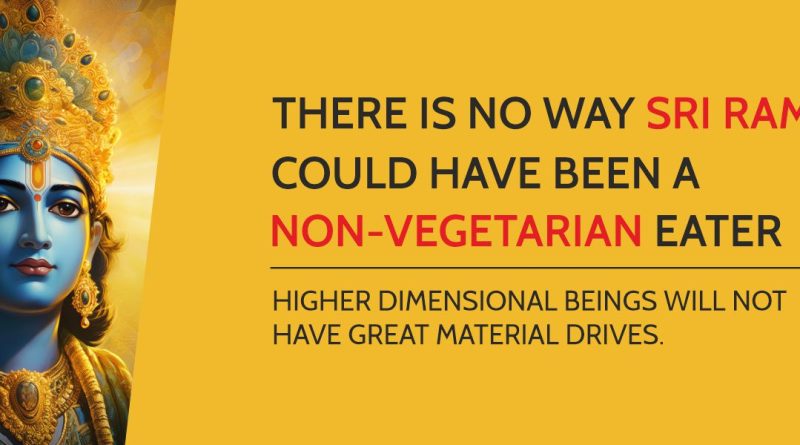
SRI RAM WAS NEVER A MEAT EATER!
Welcome to Ram Rajya!
Did Sri Rama Consume Meat? – A Spiritual Perspective
There was a time when Sri Rama ruled Ayodhya. Under his benevolent reign, the world witnessed what is often remembered as a golden age—an era of righteousness, peace, prosperity, and justice. But was this glorious period merely because he was the son of King Dasharatha? Was it because he had no enemies to challenge him? The answer lies far beyond these worldly explanations. Sri Rama was the incarnation of Lord Vishnu—Sriman Narayana Himself.
Whenever Sriman Narayana incarnates on Earth, as described in the Itihasas and Puranas, He remains the Supreme Yogi. His actions do not create karmic consequences because He exists beyond the limitations of time, space, and causation. Regardless of the manner in which His incarnation manifests on Earth, He possesses all divine attributes, including supernatural abilities, healing powers, and supreme yogic excellence. These qualities are inseparable from His divine nature. The Lord cannot incarnate while leaving behind His divinity—that is precisely why such a manifestation is called an incarnation.
This understanding naturally leads to the question: Did Sri Rama remain a vegetarian?
To appreciate this subject, one must first understand that higher-dimensional beings do not necessarily experience the ordinary human compulsions of hunger, thirst, or sleep. They descend to Earth solely to fulfil a divine purpose, remaining detached from material desires and physical necessities.
Even in the present age, we encounter glimpses of such yogic discipline. There are yogis in the Himalayas who survive for days by consuming only leaves or very little food. Actor Rajinikanth himself has spoken about spending several days in the Himalayan caves living only on leaves.
History also records that nearly 330 years ago, Sri Raghavendra Swami was once offered meat by the Nawab of Adoni. By merely sprinkling sanctified water, he transformed the offering into fruits through his spiritual power. Such incidents demonstrate only a fraction of the yogic capabilities attainable by spiritually evolved beings.
If such extraordinary yogic manifestations are still witnessed in the Kali Yuga, and if ordinary human beings can attain traces of these powers through intense spiritual practice, one can only imagine the immeasurable yogic mastery that existed during the Treta Yuga—especially in the person of Sri Rama Himself.
With this perspective, when Guha, on the banks of the Ganga, lovingly offered fish and meat to Sri Rama, it is reasonable to believe that Sri Rama, through His divine yogic power, could have transformed them into fruits before accepting them. A Kshatriya known merely for physical strength must be distinguished from a Kshatriya endowed with divine consciousness and supernatural powers. Sri Rama was never an ordinary Kshatriya king.
A striking example of His divine nature is seen when He visited the Ashram of Sage Gautama. By the mere touch of the thumb of His right foot upon a stone, He liberated Ahalya from her curse and restored her original form. Such an act reflects not only His supernatural power but also the purity and spiritual intensity that only a perfectly enlightened being can possess.
Great yogis of such stature generally speak little, eat little, and remain ever content. These qualities perfectly describe the character of Sri Rama as preserved in our sacred traditions. Since Sri Rama was the incarnation of Sriman Narayana, it is difficult to conclude that He would have accepted meat merely because He was born into a Kshatriya dynasty or to satisfy any material need.
Some confusion may have arisen from references to offerings made during homas and yajnas. These ritual offerings are intended as sacred oblations and are believed to reach the divine realm in their subtle, transformed form. Such ritual practices should not be interpreted as evidence of the dietary habits of higher-dimensional divine beings. The entire biological and genetic foundation of creation originates from the Supreme Being and ultimately returns to Him. Therefore, although Sri Rama appeared in human form as a Kshatriya, it does not necessarily follow that He consumed meat.
One must repeatedly ask a simple question: What more did the Earth have to offer Sri Rama to enhance His strength or greatness beyond what He already possessed as the Supreme Lord incarnate?
Perhaps this subject has become a matter of debate largely because human beings seek interpretations that are convenient to their own beliefs and lifestyles.
Therefore, while studying historical texts, translations, commentaries, and contemporary publications concerning the history and spiritual traditions of Bharat, one should exercise thoughtful discernment. Every text deserves respectful study, but also careful reflection before arriving at conclusions.
Warning: file_get_contents(https://api.ip2location.io/?key=879A2451407EE05791FC0B9A4E14A604&ip=216.73.216.62): Failed to open stream: HTTP request failed! HTTP/1.1 401 Unauthorized in /home/m1newsdesk/public_html/wp-content/themes/colormag-pro/content-single.php on line 201