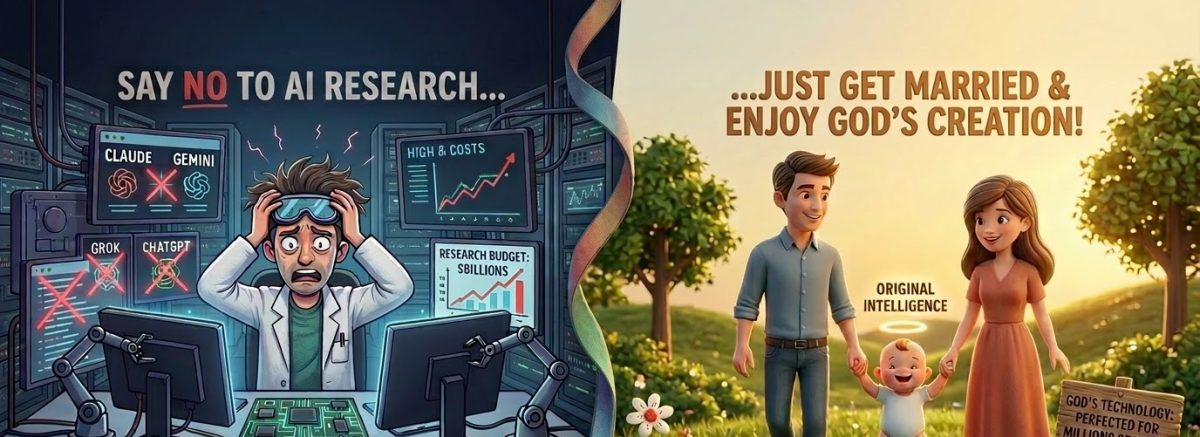
Say No Claude, Gemini, Grok, ChatGPT. Just Get Married and Enjoy God’s Creation!
You can become a master of AI & Robotics creation in no time.
Technology has travelled an extraordinary journey. We moved from calculators to computers, from computers to the internet, from smartphones to Artificial Intelligence. Today, AI can write articles, compose music, analyse data, generate images and even hold meaningful conversations. Just when we thought AI had reached its peak, scientists decided it wasn’t enough.
Their latest mission is Organoid AI—an ambitious effort to create an artificial human brain using living neural cells, combined with powerful Large Language Models and advanced neural computing. The dream is to build a machine that thinks, learns and responds almost like a human brain. It is undoubtedly a remarkable scientific pursuit. The only catch is that the research budget is climbing into billions of dollars, and it still has a long way to go.
Watching all this, I can’t help wondering if our brilliant scientists have overlooked the simplest solution. Why spend billions trying to recreate what nature has been producing perfectly for millions of years?
Here’s my humble suggestion. Find a suitable girl. Get married. Wait for about a year. Congratulations! You’ve just witnessed the arrival of the world’s most advanced biological intelligence.
No silicon chips. No GPU clusters. No trillion-parameter models. No supercomputers. No billion-dollar research grants. Just God’s Technology.
Long before humanity invented Artificial Intelligence, nature had already perfected Original Intelligence. Every human brain arrives with an extraordinary neural network, limitless learning capability, creativity, reasoning and emotions—all without a software installation or a single line of programming code.
Perhaps that’s the greatest irony of all. While the world’s finest laboratories continue investing billions trying to recreate the human brain, the greatest inventor has already demonstrated a working model countless times over.
Sometimes, the most advanced technology isn’t the one we invent. It’s the one we simply fail to appreciate.