Newton’s 300-Year-Old Law Successfully Demonstrates Its Validity in Recent Test
**New Study Reinforces Classical Theories of Gravity, Strengthens Dark Matter Hypothesis**
Recent research conducted on a cosmic scale has reaffirmed the predictions made by Sir Isaac Newton and Albert Einstein regarding the behavior of gravity in the universe. By analyzing gravitational effects across vast astronomical distances, including galaxy clusters that are hundreds of millions of light-years apart, scientists found compelling evidence supporting classical gravitational theories. This groundbreaking study, published in a prominent astrophysics journal, could have significant implications for our understanding of cosmic phenomena and the nature of dark matter.
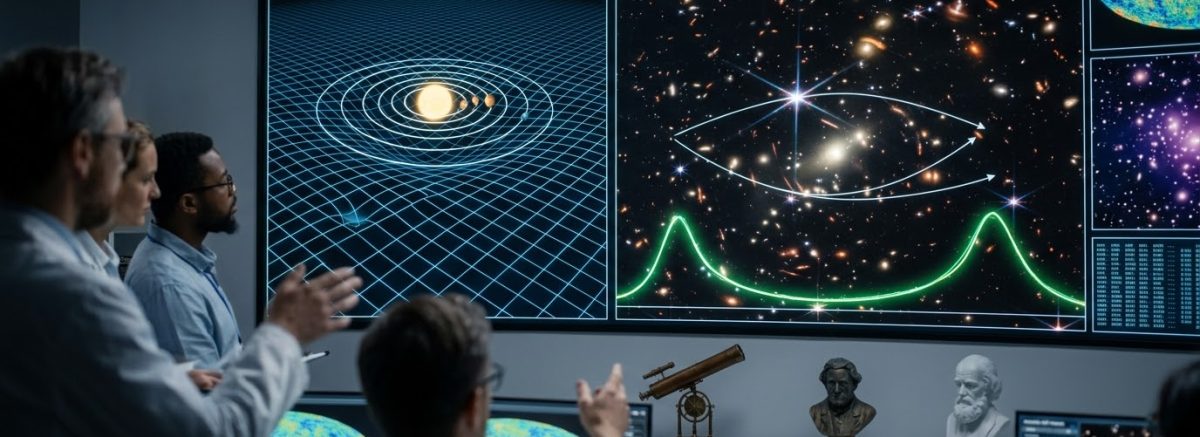
The research involved a thorough investigation of gravitational interactions within specific galaxy clusters, utilizing sophisticated models and computational simulations to analyze the gravitational lensing effects observed during these tests. Gravitational lensing occurs when massive objects, like galaxy clusters, bend the light from more distant objects behind them, allowing astronomers to infer the presence and distribution of mass, including both visible matter and dark matter.
The findings indicated that gravity operates in accordance with Einstein’s General Relativity and Newtons laws, even in regions of the universe where gravity is influenced by extreme conditions, such as the merging of galaxy clusters. This consistency challenges several modified gravity theories that have attempted to provide alternative explanations for gravitational phenomena without the need for dark matter—an elusive and largely invisible component that is believed to make up a significant portion of the universes total mass.
Dark matter, which does not emit, absorb, or reflect light, has been a topic of extensive study due to its inferred effects on the structure and dynamics of galaxies and galaxy clusters. The evidence gathered from this recent study strengthens the argument for the existence of dark matter as a critical factor in explaining the universes overall mass discrepancies, which have historically perplexed astronomers. Additionally, the reinforcing of established gravitational theories may encourage further research into the nature of dark matter, as scientists seek to identify its properties and potential particle candidates.
Notably, the study’s findings have broad implications beyond theoretical physics. Understanding gravity and dark matter is crucial in cosmology, impacting interpretations of the universe’s evolution, structure formation, and the ultimate fate of cosmic expansion. Furthermore, this research enhances our grasp of gravitational waves and how they might interact with matter and energy across vast scales.
In summary, this massive test of gravity not only underscores the reliability of classical theories proposed by Newton and Einstein but also consolidates the case for dark matter as a fundamental element of our universe. As researchers continue to unravel the complexities of gravitational interactions, the quest to understand the dark components of the cosmos remains at the forefront of astrophysical inquiry and discovery.