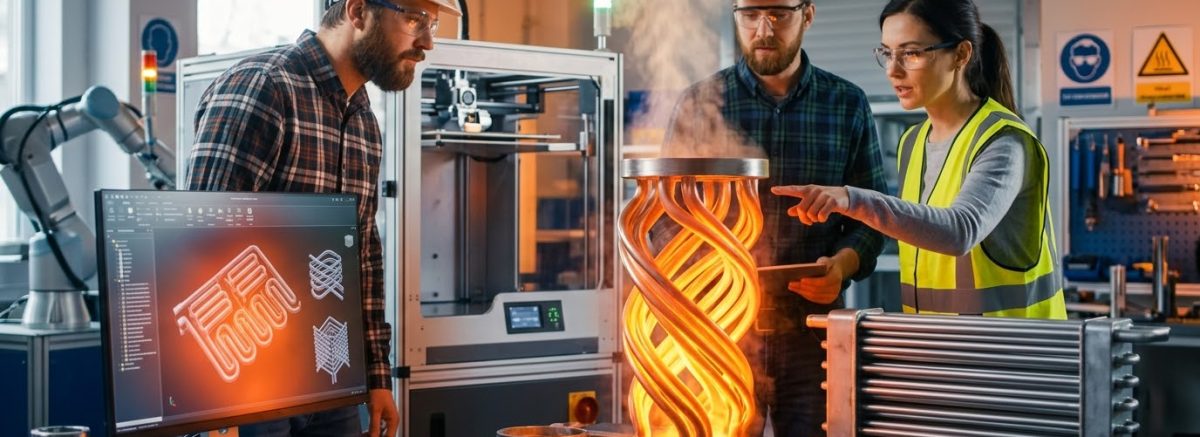
Engineers Innovate with Advanced Toolbox to Develop High-Performance Heat Exchanger
**Engineers Develop Innovative Twisty High-Temperature Heat Exchanger for Enhanced Performance**
A team of engineers has successfully designed a novel high-temperature heat exchanger that significantly surpasses the efficacy of traditional straight channel heat exchangers. This cutting-edge exchanger not only demonstrates superior heat transfer capabilities but also excels in power density and overall effectiveness. This breakthrough was achieved through an innovative approach that incorporates advanced 3D printing techniques to create and test a proof of concept made from metal.
Heat exchangers are essential components in various industries, ranging from power generation and refrigeration to automotive and aerospace applications. Their primary function is to transfer heat between two fluids without mixing them, providing energy efficiency in numerous processes. Traditionally, straight channel heat exchangers have been the go-to design, primarily due to their simplicity and ease of manufacturing. However, these designs can often lead to suboptimal performance, particularly in high-temperature applications.
The newly developed twisty heat exchanger features a series of intricate curves and bends that promote enhanced fluid dynamics. This innovative geometric design allows for improved turbulence and increased surface area contact between the fluids, leading to more efficient heat transfer. The engineers involved in this project have carefully optimized these design parameters to achieve what they describe as “striking results” in heat transfer rates and power density enhancements, which are critical metrics in evaluating heat exchanger performance.
Furthermore, the application of cutting-edge 3D printing technology has allowed the team to efficiently produce a metal proof of concept. This manufacturing method not only accelerates the development process but also enables the creation of complex geometries that would be challenging to achieve through traditional manufacturing techniques. By utilizing 3D printing, the engineers were able to iterate on their design rapidly, testing various configurations to arrive at an optimal solution. The use of advanced materials capable of withstanding high temperatures further complements the design, making it particularly suitable for demanding environments.
In recent tests, the twisty heat exchanger has demonstrated its potential to operate effectively at elevated temperatures, which is critical for applications in industries like energy generation and chemical processing where high thermal efficiency is paramount. The results show a clear trajectory towards reducing operational costs and increasing energy output, addressing a vital need in todays energy-conscious landscape.
As the team moves forward, they aim to gather more data from ongoing tests and refine their designs further. Their work holds the promise of significant advancements in heat exchanger technology, which could yield substantial benefits across multiple sectors. The potential impact on energy efficiency and emissions reduction makes this innovation a noteworthy development in the realm of engineering and environmental sustainability.
The next steps for the team will involve scaling the prototype for broader applications and considering commercial partnerships to advance this technology into practical, widespread use. This innovative approach to heat exchange technology reflects a growing trend in engineering towards integrating advanced manufacturing processes and optimizing thermal management to meet the increasing demands of modern industry.