AI Technology Enables Real-Time Translation of Sign Language by Engineers
**Advancements in American Sign Language Recognition: A Breakthrough System Achieves 98.2% Accuracy**
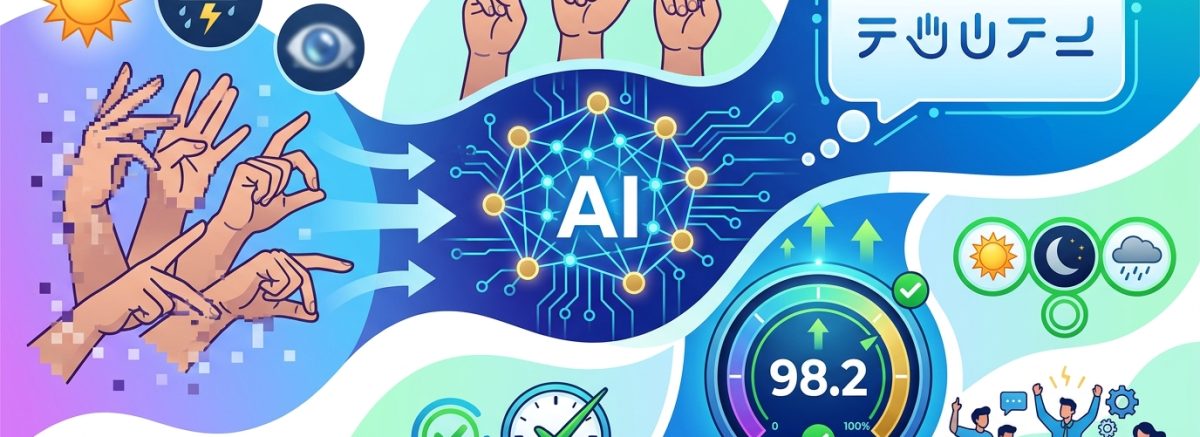
American Sign Language (ASL) recognition has faced significant challenges as a result of the complexity of hand gestures, variations in lighting, and image quality. Traditional systems frequently struggle to translate the nuances of ASL due to the similarity between certain gestures, which can lead to errors in interpretation. Recognizing the need for improvement in this area, researchers recently introduced a revolutionary system capable of translating ASL gestures into text with an impressive accuracy rate of 98.2%. This innovative solution operates in real time and adapts effectively to various environmental conditions.
The system primarily leverages the capabilities of a standard webcam combined with advanced gesture-tracking technologies. By utilizing MediaPipe, a framework developed by Google, the system identifies and tracks 21 keypoints on each hand, allowing it to capture the most intricate movements associated with ASL. The precise tracking is essential for understanding the context and meaning behind the gestures, particularly as many signs involve subtle nuances that can change the interpretation of a gesture.
To complement the gesture tracking, the system employs a sophisticated deep learning model known as YOLOv11 (You Only Look Once version 11). This model is trained to classify ASL letters accurately, meeting the demands of real-time processing. YOLOv11 uses a cutting-edge convolutional neural network to analyze images quickly and make predictions about the signs being made. Its ability to function effectively under different lighting conditions and with varying image quality significantly enhances the systems usability and accessibility.
One of the critical advantages of this newly developed ASL recognition system is its scalability. Designed for easy implementation, it can be deployed in a variety of real-world scenarios. For instance, it can be utilized in education to aid in ASL teaching, in public services to facilitate communication between hearing individuals and members of the deaf community, or even in personal devices for hands-free communication.
In addition to enhancing communication for the deaf and hard-of-hearing community, this advancement in ASL recognition technology holds the potential to bridge gaps in accessibility across various sectors, including healthcare, customer service, and entertainment. As society continues to emphasize inclusivity, innovations like this are crucial in helping those with hearing impairments connect more easily and effectively with others.
As this technology progresses, ongoing research will likely focus on further improving the systems accuracy and efficiency, particularly in more challenging environments. Additionally, efforts may be made to enhance the emotional recognition of signs, which could provide an even richer understanding of ASL nuances.
In conclusion, the development of an ASL recognition system that boasts a 98.2% accuracy rate represents a significant stride toward improved communication and inclusivity for the deaf and hard-of-hearing populations. By combining powerful image processing technologies with real-time functionality, this advancement paves the way for a future where effective communication is accessible to everyone.