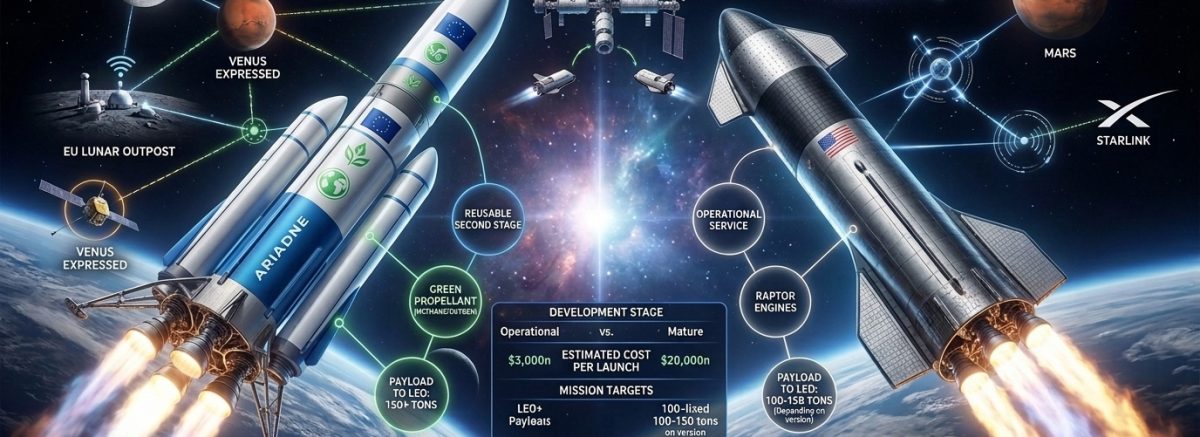
Europe Introduces New Competitor to SpaceXs Starship
A comprehensive independent study has affirmed that SpaceXs Starship project is indeed as groundbreaking as anticipated, with the findings shedding light on both its remarkable capabilities and the significant challenges that still lie ahead. The research, which aims to evaluate the technological and operational aspects of space launch vehicles, provides insights into Starship’s performances in various mission profiles and its potential to revolutionize space travel.
Starship, which is designed to be a fully reusable spacecraft capable of carrying humans and cargo to destinations including Mars and beyond, has been a focal point of SpaceXs long-term vision for interplanetary exploration. The study highlighted notable features of Starship, such as its impressive payload capacity, which is projected to be able to transport over 100 metric tons to low Earth orbit. Additionally, Starship boasts a unique stainless-steel construction that enhances durability and performance during re-entry and offers a high degree of thermal protection.
As impressive as these advancements are, the study does not overlook the hurdles that SpaceX must address before executing its ambitious plans for Starship. Among these challenges are the need for regulatory approval, environmental concerns related to frequent launches, and the development of efficient ground support infrastructure. Furthermore, the study identified technical challenges associated with the Raptor engines, which power Starship and must be optimized for performance and reliability.
In tandem with the SpaceX analysis, researchers introduced a novel European rocket concept, designed to provide an alternative approach to achieving affordable super-heavy launches. This European initiative aims to reduce the dependency on existing launch systems by advancing new technologies that could achieve similar efficiencies at potentially lower costs. Key elements of this proposed rocket include innovative propulsion systems, modular designs that prioritize reuse, and a focus on environmental sustainability.
The emergence of this European rocket concept is indicative of a growing global interest in space exploration and the competitive landscape surrounding launch capabilities. As the market for satellite deployment, space tourism, and deep-space exploration expands, various entities are racing to develop next-generation vehicles that can meet the demands of a rapidly evolving industry.
In conclusion, the independent study underscores the revolutionary potential of SpaceXs Starship while simultaneously pointing out the considerable challenges that remain. With ongoing advancements in aerospace technology, and the introduction of competitive models like the European rocket concept, the future of space exploration looks poised for significant transformation, potentially making space travel more accessible and sustainable. As these developments unfold, they will shape the trajectory of humanitys journey into the cosmos.