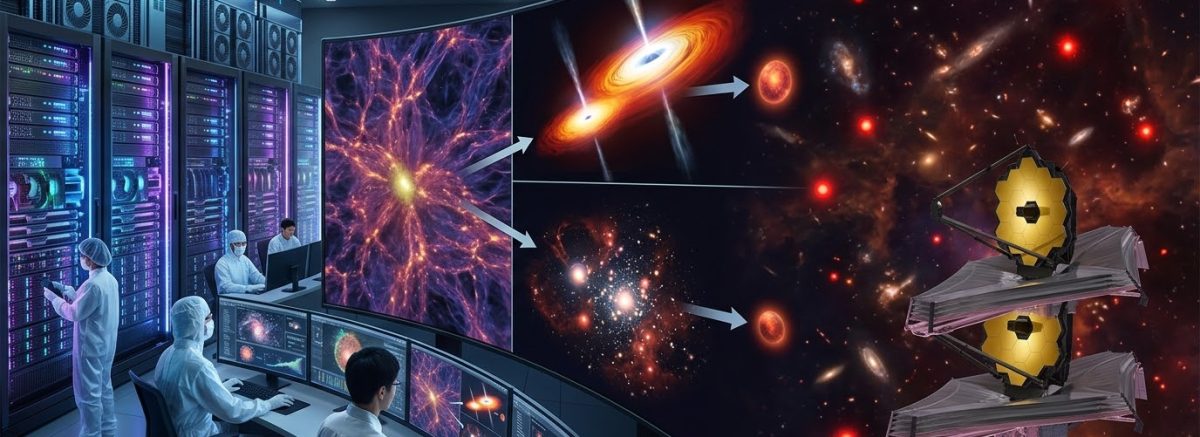
Japanese supercomputer simulations may clarify the origins of Webbs Little Red Dots.
Recent research involving Japanese supercomputer simulations has shed light on the enigmatic Little Red Dots observed by the James Webb Space Telescope (JWST). These features, thought to be linked to early stages of black hole formation, have sparked extensive scientific discussion and investigation.
The simulations suggest that these Little Red Dots may be related to overmassive black holes and could form naturally in the early universes conditions. A team of astronomers argues whether these dots may represent either black holes or black hole stars, displaying the vivid debate within the scientific community on their true origin and nature.
Additionally, a recent study links these mysterious formations with the early emergence of quasars and supermassive black holes, hinting at their role in cosmic evolution. The conversation around these discoveries was prompted by JWSTs unprecedented ability to capture detailed images of the cosmos, revealing complex structures that challenge our understanding of astrophysics.
As researchers continue to analyze the data from JWST and refine their simulations, new insights may soon address the unresolved questions surrounding these intriguing celestial phenomena, significantly enhancing our grasp of the universes formative years.
Warning: file_get_contents(https://api.ip2location.io/?key=879A2451407EE05791FC0B9A4E14A604&ip=216.73.217.55): Failed to open stream: HTTP request failed! HTTP/1.1 401 Unauthorized in /home/m1newsdesk/public_html/wp-content/themes/colormag-pro/content-single.php on line 201