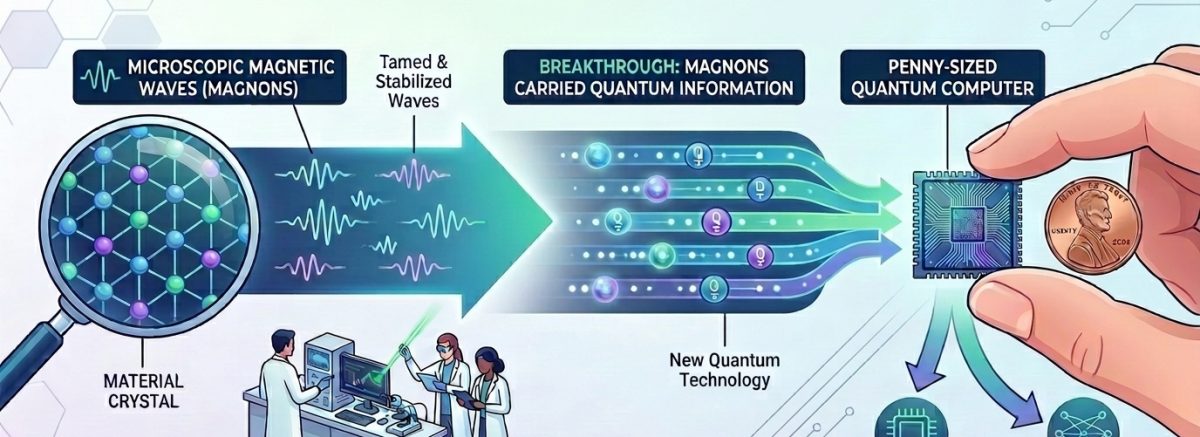
Microscopic Magnetic Waves May Enable Development of Penny-Sized Quantum Computers
In recent advancements in quantum technology, researchers have achieved a significant breakthrough by transforming magnons—tiny magnetic waves often deemed too ephemeral for practical applications—into viable carriers of quantum information. This development is critical in the fields of quantum computing and quantum communication, as it offers new avenues for enhancing the efficiency and reliability of these technologies.
The research team managed to extend the lifetime of magnons by nearly 100 times, achieving an impressive duration of up to 18 microseconds. This increase in longevity is pivotal as the ability to maintain coherence—the time during which a quantum state remains stable—is crucial for any quantum technology application. The findings indicate that the primary limitation to magnon lifespan is not an inherent physical law, but rather the purity of the material in which the magnons are generated and propagated. This opens the door for substantial improvements through advancements in material science and manufacturing processes.
Magnons operate at the atomic scale and represent a form of quasiparticle associated with the collective spin alignment of electrons within a magnetic material. They are promising candidates for transporting quantum information because of their potential for low-energy dissipation compared to other means of information transfer. The ability to manipulate and harness magnons effectively could play a significant role in the development of more efficient quantum bits (qubits), which are the fundamental building blocks of quantum computing.
The implications of this breakthrough could be profound. In the realm of quantum computing, enhanced magnon lifetimes could lead to longer-lasting qubits, allowing for more complex calculations and robust quantum algorithms. Furthermore, in the context of quantum communication, improved magnon systems could facilitate the secure transfer of information over longer distances.
This discovery emphasizes the importance of material quality in cutting-edge technology. By focusing on the purity of magnetic materials, researchers could optimize magnon behavior, leading to substantial advancements not only in quantum technologies but also in various industries dependent on precision electronics and data communication.
Overall, this innovative approach underlines a new paradigm within the realm of quantum information science, hinting that the key to unlocking the potential of magnons lies in refining our existing materials, rather than searching for entirely new phenomena. The continuing exploration into this domain is anticipated to yield further exciting developments that could redefine the landscape of quantum computing and information transfer in the coming years.