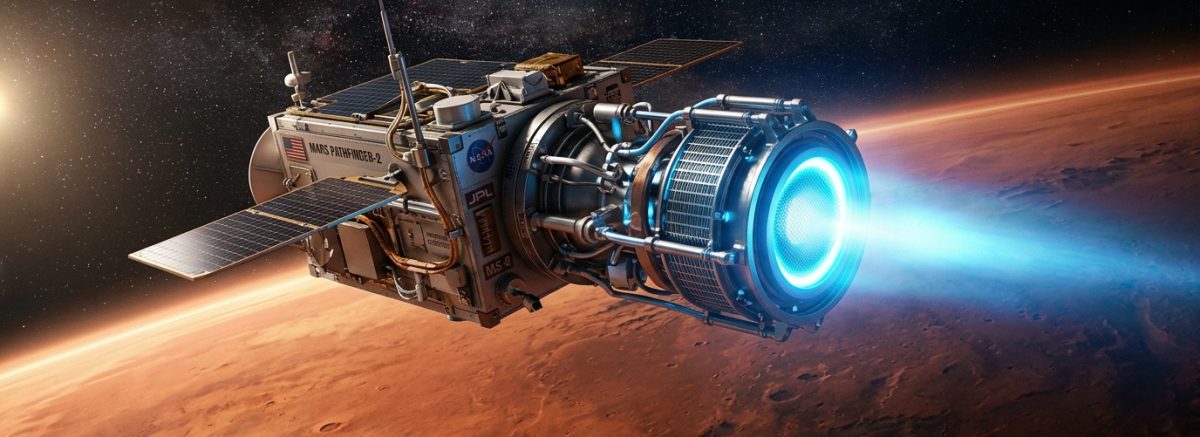
MIT Develops Innovative Spacecraft Engine for Deploying Miniature Satellites to Mars
Researchers at the Massachusetts Institute of Technology (MIT) have unveiled an innovative propulsion technology that could revolutionize the capabilities of small satellites by utilizing a single type of fuel for both chemical and electric spacecraft thrusters. This groundbreaking development marks a significant step toward enhancing the efficiency and versatility of satellite operations in space.
The new propulsion system is designed to provide a dual-function capability, enabling spacecraft to achieve quick bursts of speed for maneuvers alongside highly efficient long-range propulsion. This amalgamation of two propulsion methods into a single compact system not only simplifies the design and operation of spacecraft but also potentially reduces costs and weight, critical factors for small satellite missions.
Currently, most satellites employ either chemical propulsion systems, which provide high thrust and are suitable for short-duration maneuvers, or electric propulsion, which is more fuel-efficient for extended missions. However, these systems have traditionally required different types of fuel or separate equipment, leading to complexities in design and operational logistics. MITs new system optimizes performance by using one type of fuel for both propulsion methods, thus streamlining satellite construction and enhancing operational capabilities.
To bring this technology from the laboratory to real-world applications, a CubeSat mission supported by NASA is on the horizon. This mission is set to test the new propulsion technology in orbit, providing crucial data on its effectiveness and potential for future space missions. CubeSats, which are miniature satellites typically used for educational or research purposes, will serve as an ideal platform for this test due to their low cost and ability to be launched in groups.
The anticipated CubeSat mission will not only assess the performance of the new propulsion system but will also provide insights into how this technology can be leveraged for various space operations, including Earth observation, telecommunications, and deep-space exploration. By allowing small satellites to maneuver more flexibly and efficiently, this innovation could enable more ambitious missions and broaden the scope of research and commercial endeavors in space.
As the demand for smaller, more capable satellites continues to grow, the implications of MIT’s research extend beyond academic interest. The technology has significant potential for the burgeoning satellite industry, which has seen rapid expansion in recent years. Enhanced propulsion systems could enable quicker deployments, improved efficiency, and broader applications for satellite technology across different sectors.
In summary, MITs innovative dual-propulsion technology marks a pivotal advancement in the design of spacecraft, promising to enhance the capabilities of small satellites significantly. With a NASA-supported mission set to validate this groundbreaking approach, the future of satellite technology may very well be on the brink of transformation, ushering in new opportunities for exploration and application in the vast expanse of space.