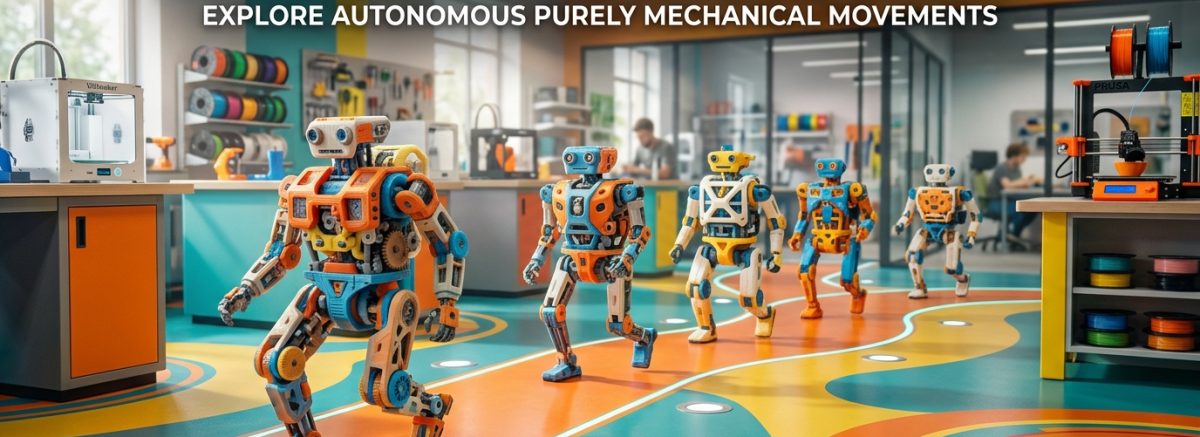
“New Electronics-Free Robots Can Be 3D-Printed and Walk Independently”
**Innovative 3D-Printed Robot Walks Without Electronics Using Compressed Gas**
In a groundbreaking development within the field of robotics, researchers have unveiled a novel robot capable of walking autonomously without the need for electronic components. This innovative robot, which can be produced entirely using 3D printing technology, utilizes a unique system powered solely by compressed gas, exemplifying the advancements in automated engineering and materials science.
The robot is designed to be printed as a single piece using a specialized material, allowing for streamlined production. This eliminates the complexity and assembly time typically associated with conventional robotic systems, which often require multiple components and extensive wiring. By utilizing a single material, the manufacturing process is not only simpler but also produces a more cohesive and durable structure, potentially leading to increased reliability in various applications.
One of the most striking characteristics of this robot is its ability to move through a mechanism that relies solely on the actuation of valves and chambers activated by compressed gas. When the gas is released into these chambers, it facilitates motion through strategic depressurization and directional force, creating a dynamic walking motion. This mechanism allows for a lightweight design while still maintaining functional efficiency.
Researchers involved in this project have highlighted the potential for this technology to be used in various fields, including search and rescue operations, environmental monitoring, and even in exploring areas that are difficult for traditional machines to navigate, such as disaster-struck regions or uneven terrains. The ability to create a robot that does not rely on heavy electronics can also lead to environmentally friendly applications, as it reduces the need for battery-operated systems that contribute to electronic waste.
Moreover, the application of 3D printing technology not only accelerates the manufacturing process but also opens possibilities for customization. Depending on the requirements of a specific task, the robot can be modified in size and function without significant redesign efforts, offering flexibility that could be beneficial in diverse scenarios.
As the research progresses, the team is working on enhancing the efficiency of the walking mechanism and exploring different materials that may further improve the robot’s performance. This invention marks a significant milestone in robotics, paving the way for future innovations where simplicity and ecological considerations are at the forefront.
Overall, the introduction of a 3D-printed robot that operates without electronics and utilizes compressed gas as its power source represents a unique convergence of technology, sustainability, and practical application, showcasing how modern engineering can meet the challenges of tomorrows world. Further developments in this area may lead to a new generation of robots that can adapt to various environments, potentially revolutionizing the way robotic systems are constructed and utilized.