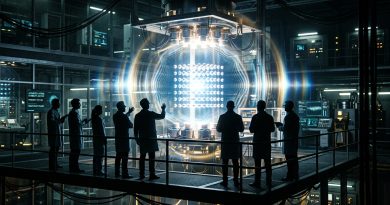
Scientists Create Crystal Sculpture of Einstein Using Light Techniques
**Advancements in Light-Written Technology Using Arsenic Trisulfide**
Recent developments in the field of photonics have showcased the potential of a light-sensitive crystal known as arsenic trisulfide (As2S3) to revolutionize various technologies through a process commonly referred to as “light-written” technology. This innovative technique allows for the reshaping and permanent alteration of materials using nothing more than light, enabling the creation of ultra-fine optical patterns without the need for traditionally expensive manufacturing tools.
Arsenic trisulfide, a chalcogenide glass, has garnered attention due to its unique optical properties that respond favorably to light exposure. By employing focused laser beams, scientists can manipulate the material’s structure on a nanoscale level. This was exemplified in a recent project where researchers successfully etched a nanoscale portrait of the iconic physicist Albert Einstein into the crystal. This artistic representation not only highlights the capabilities of arsenic trisulfide but also showcases how light can be used to produce intricate designs that were previously thought to be limited to more costly manufacturing methods.
Furthermore, research teams have explored the development of high-density optical patterns that can serve as secure optical signatures, which introduces application possibilities in cybersecurity and anti-counterfeiting measures. Such signatures could offer a robust method for protecting sensitive information and valuable products from forgery.
The implications of this breakthrough extend far beyond artistic representations or security features. The ability to engineer optical patterns on such a small scale could significantly impact industries ranging from telecommunications to healthcare. For example, advanced sensors utilizing these light-written technologies could lead to improved diagnostic tools in medicine, enhancing the precision and efficiency of medical imaging.
Additionally, the integration of this technology into next-generation augmented reality (AR) devices could pave the way for new user experiences. By allowing for customized and dynamic displays that adapt to users interactions, the potential for immersive environments increases, opening doors to innovative applications in gaming, education, and beyond.
In conclusion, the advent of arsenic trisulfide and its capability for light-induced alterations marks a pivotal moment in the development of cutting-edge technologies. As researchers continue to explore its full potential, the light-written technology may well become a cornerstone of future advancements, creating opportunities for new devices and systemic improvements across various sectors. This exciting journey into the realms of light manipulation will likely yield a plethora of applications, establishing a new standard in manufacturing and technology integration.