“Evidence of Historical Solar Storm Event Identified Through Dendrochronological Analysis of Ancient Trees”
**Unveiling a Medieval Solar Storm: Insights from Tree Rings and Historical Records in Japan**
In a groundbreaking study, researchers in Japan have revealed significant insights into a hidden solar storm that occurred during the Middle Ages, specifically around 1200 CE. This exploration combines innovative approaches by examining ancient tree rings alongside historical sky observations, which offers an unprecedented look into solar activity from that era.
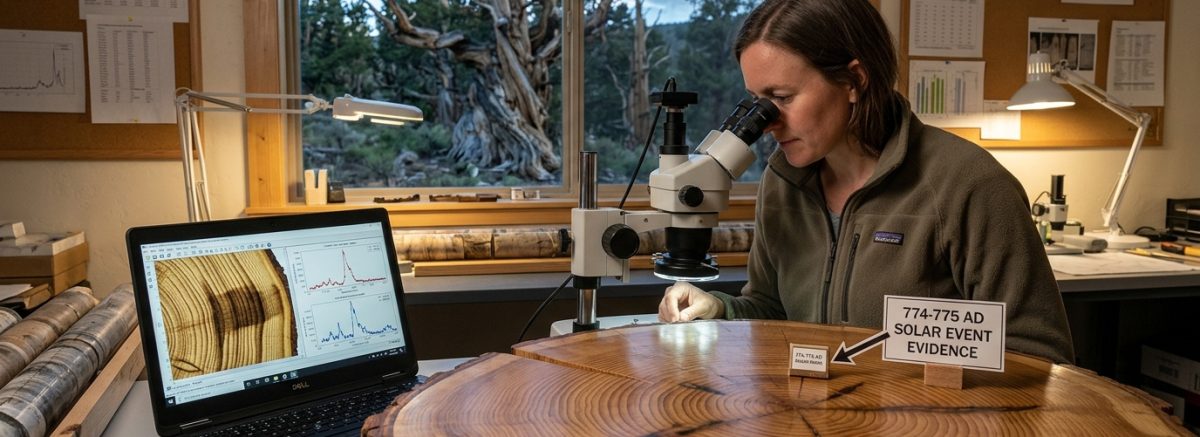
The team, led by researchers from the Tokyo Institute of Technology and other institutions, sought to understand unusual patterns in the Earths atmosphere that corresponded with a period of notable climatic changes. Their analysis focused on the correlation between historical accounts of intense red auroras, documented in ancient texts, and spikes in carbon-14 isotopes identified in preserved wood samples. Carbon-14, a radioactive isotope formed by cosmic rays interacting with the atmosphere, serves as a crucial marker for assessing past solar events.
The findings revealed that there were significant increases in carbon-14 levels during this time, which suggests that a powerful solar radiation event occurred, possibly caused by an exceptionally energetic solar flare or coronal mass ejection. According to the researchers, this event is thought to be related to periods of extreme solar activity known as solar maximum, characterized by shorter solar cycles, which occur when the Sun exhibits particularly high levels of sunspots and solar output.
Historical records from Japan and other regions document unusual and vivid red auroras during this period, phenomena typically triggered by intense solar storms interacting with the Earths magnetic field. Such atmospheric displays were not only noted in East Asia but were also reported throughout Europe and North America, signifying that intense solar activity likely had a global reach, affecting various regions in unique ways.
The implications of this research are manifold. Understanding the nature and frequency of powerful solar storms can inform contemporary scientific inquiries, especially regarding climactic effects on Earth. Solar storms have the potential to disrupt modern infrastructure, including satellite communications, power grids, and navigation systems, making it vital for current society to be aware of historical solar behavior patterns.
This research not only enriches the field of solar physics but also highlights how interdisciplinary techniques—combining dendrochronology (the study of tree rings) and historical astronomy—can enhance our understanding of past solar activity and its effects on Earth. As the sun continues to undergo natural cycles of activity, lessons drawn from the medieval period can help inform risk assessments and preparedness strategies for potentially harmful solar events in the future.
The studys findings have been published in the prestigious journal *Nature Communications*, and the research team hopes that their work will encourage further investigations into the relationship between solar activity and historical climate phenomena, providing vital context for understanding both past and future environmental challenges.
Array
(
    [ip] => 216.73.217.70
    [timezone] => America/New_York
    [country] => United States
    [country_code] => US
    [state] => Ohio
    [city] => Columbus
)
)