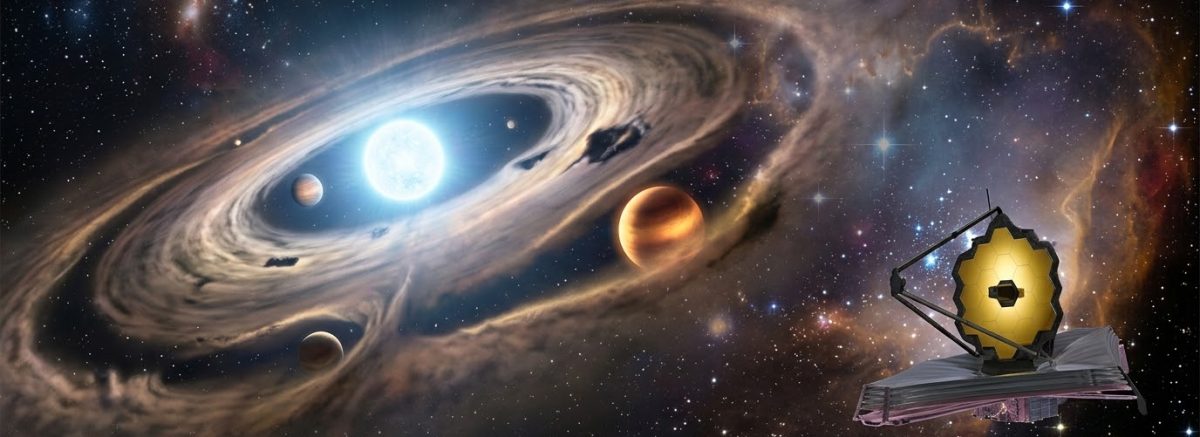
NASAs Webb Telescope Identifies Large Planet in Renowned Astronomical System
In a groundbreaking discovery, astronomers utilizing the James Webb Space Telescope (JWST) have unveiled the existence of a giant planet, designated Beta Pictoris d, within the renowned Beta Pictoris system. This planetary system, located approximately 63 light-years from Earth, has long been a subject of interest in the astronomical community, primarily due to its bright disk of cosmic dust that encircles the star, making it a rich environment for studying planetary formation.
Beta Pictoris is a young star, about 23 million years old, and is surrounded by a protoplanetary disk, which is a notable feature that indicates active planetary formation. The planet’s discovery comes as a significant advancement in exoplanet research, especially considering that its presence was obscured by the densely packed dust and gas in the area surrounding the star. The JWST, operational since July 2022, has enabled scientists to investigate these complex environments with unparalleled clarity.
The new findings highlight the ability of the JWST to detect atmospheric compounds associated with the planet, including crucial elements like carbon monoxide, water vapor, and methane. The identification of these substances suggests tantalizing details about the planets environment. Analyzing the chemical signatures of exoplanet atmospheres provides insight into their composition, weather patterns, and potential for habitability.
Beta Pictoris d is classified as a gas giant, akin to Jupiter in our solar system. The detailed observations made by the JWST signify a promising new methodology for identifying and studying exoplanets, especially those shrouded in dust or otherwise difficult to observe. Researchers anticipate that this approach can be applied to various other systems, expanding our understanding of planetary diversity and formation across the universe.
The discovery has garnered considerable excitement among scientists and astronomers, as it exemplifies the advanced capabilities of the JWST, which has been crafted specifically to enhance our understanding of distant worlds. The telescope’s instruments allow for high-contrast imaging and spectroscopy, which are essential for unraveling the complex atmospheres of distant exoplanets.
Future observations will likely delve deeper into the climatic conditions and potential habitability of Beta Pictoris d and similar planets. The JWST thus not only marks a technical achievement but also serves as a powerful tool for unlocking the mysteries of the cosmos.
In summary, the discovery of Beta Pictoris d signifies a crucial leap forward in exoplanet discovery and characterization, providing astronomers with enhanced methodologies to uncover the secrets hidden within vibrant planetary systems. As the research continues, the implications of this finding will likely continue to unfold, reshaping our understanding of the dynamics of star systems and the potential for planetary life beyond our Solar System.