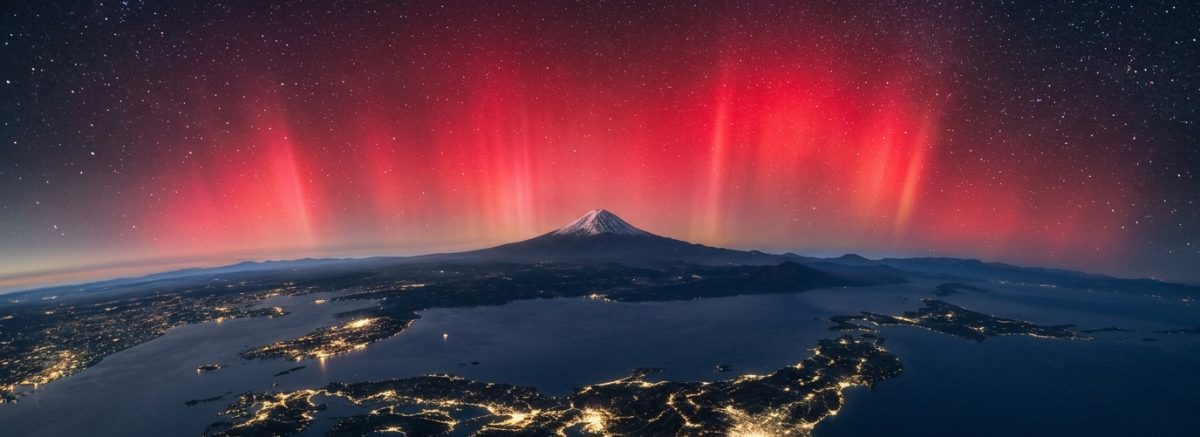
Scientists observe large red auroras extending into space over Japan
**Mysterious Red Auroras Observed Over Japan: Implications for Solar Activity and Satellites**
In a recent and astonishing meteorological phenomenon, researchers and astronomers have reported sightings of vibrant red auroras over Japan, reaching altitudes that exceed what were previously considered normal boundaries for such events. Auroras, typically associated with geomagnetic storms resulting from solar wind, are predominantly seen in polar regions. However, this new occurrence has captivated scientists, as these red auroras were not only unexpected but also appeared during space weather events that were classified as relatively mild.
The auroras observed over Japan exhibit a striking crimson hue, which is attributed to high-energy particles interacting with the Earths atmosphere, leading to ionization at greater altitudes than previously measured. It is known that auroras are usually green, a product of oxygen molecules at lower altitudes; however, the emergence of red auroras highlights a more complex interaction between solar wind and the Earth’s magnetic field than what was once understood.
Researchers have pointed out that the altitudes reached by these red auroras were significantly higher, sometimes extending beyond 400 kilometers (about 250 miles) into the atmosphere. This elevation raises important questions regarding the intensity and nature of solar activity during these “mild” solar storms, prompting scientists to reconsider their models of space weather. The unexpected strength of these auroras indicates that particularly active solar processes may not always correspond to more severe geomagnetic storms, which challenges existing knowledge.
The implications of these findings extend beyond atmospheric phenomena. With the ever-increasing reliance on satellite technology for communication, navigation, and weather monitoring, stronger-than-anticipated solar activity poses potential risks to satellites orbiting Earth. Increased levels of energetic particles can damage the electronics onboard satellites, disrupt their functionality, and even lead to early degradation of services. Engineers responsible for satellite design and operation may need to account for this newly observed solar behavior to safeguard against unanticipated disturbances.
Moreover, this discovery reignites discussions on the importance of continuous monitoring of solar activity and its effects on near-Earth space. As researchers deploy more advanced satellite technology for space weather forecasting, these recent observations could inform models and lead to better preparedness for potential disruptions caused by solar events.
The phenomenon of red auroras is not entirely new, with occasional reports from different parts of the world, but the high altitudes observed over Japan bring a new layer of interest to the study of geomagnetic phenomena and their implications. As scientists continue to analyze this occurrence, it paves the way for further research into solar-terrestrial interactions and enhances our understanding of Earths magnetosphere.
In summary, the sightings of red auroras in Japan mark a significant moment in the study of space weather, revealing that hidden solar activity might be more potent than previously understood. As the scientific community delves deeper into the implications of this phenomenon, there is a renewed focus on protecting our satellite infrastructure while enhancing our grasp of the complexities of space weather dynamics.
The image associated with this article is graphically simulated. Redears discreaton is recommanded.