New Research Suggests Particles May Diverge from Einsteins Predictions
In a groundbreaking development in theoretical physics, a team of researchers from TU Wien (Vienna University of Technology) has made significant strides in bridging the long-standing divide between quantum mechanics and Einsteins theory of gravity. For decades, scientists have been grappling with what is often referred to as the “quantum gravity problem,” an endeavor to reconcile the bizarre and probabilistic nature of quantum mechanics governing the minute world of particles with the deterministic framework established by Einstein for massive objects and cosmic phenomena.
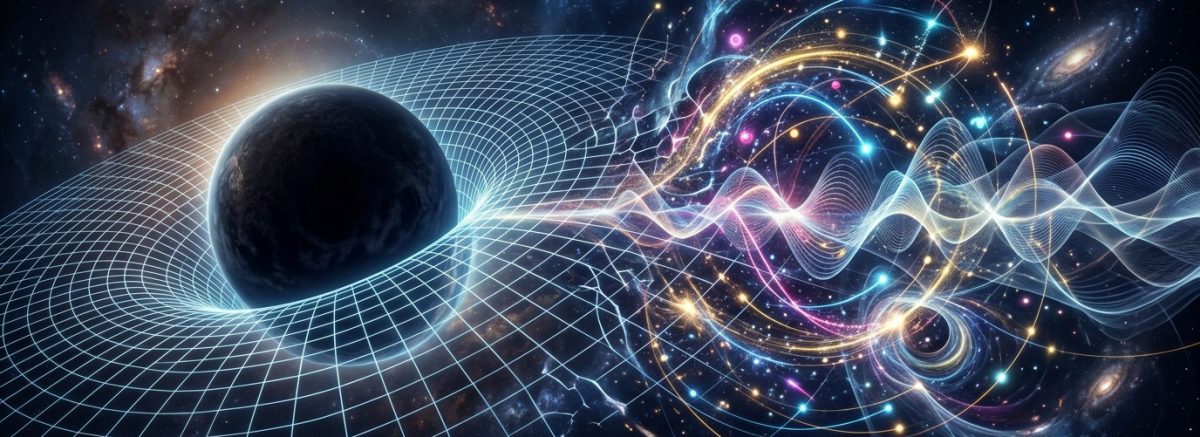
Central to this challenge is the concept of spacetime, a four-dimensional continuum where the fabric of the universe is intricately woven together by the forces of gravity as outlined in Einsteins General Theory of Relativity. In this theory, the paths that particles take when moving through curved spacetime are referred to as geodesics. These pathways, akin to the shortest distance between two points on a curved surface, dictate how objects move under the influence of gravity.
In their latest study, the TU Wien research team proposed a fresh perspective on these geodesics by introducing a quantum variant dubbed the q-desic equation. This innovative formulation posits that when particles traverse a quantum variant of spacetime—essentially a more nuanced understanding of the energetic landscape at small scales—there may be minute deviations from the classical paths predicted by traditional relativity. As such, this advancement could lead to a more comprehensive model that encapsulates both quantum mechanics and gravitational forces.
The implications of this research are profound. If validated, the q-desic equation could pave the way for new understanding in fields like cosmology, high-energy physics, and even the ultimate nature of spacetime itself. Understanding these deviations sheds light on phenomena that occur at extreme scales, such as black holes and the early universe, where both quantum effects and gravity play crucial roles.
Moreover, this work is not merely a theoretical exercise; it could influence future experiments designed to test the predictions made by quantum gravity theories. Researchers aim to design experiments that can verify the existence of quantum effects on geodesics, which may further illuminate how gravity operates at subatomic scales.
As theoretical physicists continue to delve into this complex intersection, the work by the TU Wien team stands as a compelling testimony to the importance of innovative thinking in addressing one of physics most fundamental challenges. With ongoing advancements and exploration into quantum gravity, the quest for a unified theory that encompasses both quantum mechanics and gravity could inch closer to realization, offering deeper insights into the universes enigmatic structure and behavior.