Traditional Jewelry Technique May Revolutionize Nuclear Timekeeping
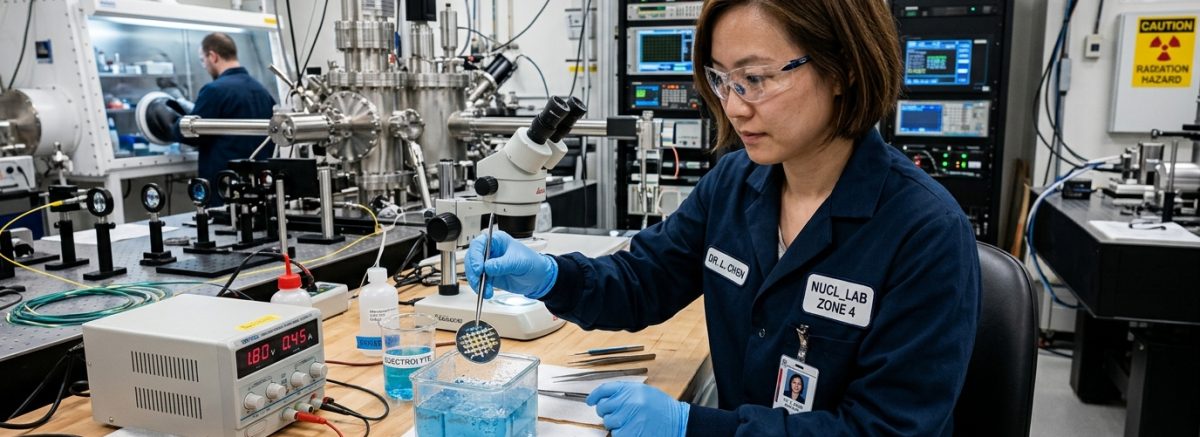
A groundbreaking advancement in the field of precision timekeeping has been achieved by a team of physicists, who have devised a remarkably straightforward method for constructing nuclear clocks utilizing minimal quantities of the rare element thorium. This innovative technique involves the electroplating of thorium onto steel surfaces, resulting in a significant leap in efficiency compared to traditional methods that rely on delicate crystal structures.
Nuclear clocks represent a new frontier in timekeeping technology, with the potential to exceed the precision of existing atomic clocks by a substantial margin. Currently, atomic clocks, which are based on the vibrations of atoms, serve as the backbone for a variety of applications, including global positioning systems (GPS), telecommunications, and scientific research. However, these systems are often limited in environments where GPS signals cannot penetrate, such as deep underwater or in deep space. The new nuclear clocks, developed using thorium, could offer reliable timing solutions in these challenging conditions.
The thorium-based nuclear clocks work on principles of nuclear resonance, exploiting the unique properties of thorium isotopes to produce highly stable frequencies. This stability is crucial, as even the tiniest discrepancies in timekeeping can lead to significant errors in navigation and communications systems. By leveraging electromagnetics and sophisticated sensor technology, these clocks could mark a new era in our understanding of time measurement.
The implications of this development extend beyond mere timekeeping and into multiple disciplines such as navigation, physics, and engineering. For instance, improved precision in timekeeping would enhance the synchronization of satellite networks, thereby improving communication systems across the globe. Similarly, in scientific research, where precise timing is essential, these nuclear clocks could enable more accurate measurements in experiments related to fundamental physics, potentially leading to new discoveries regarding the universe and its laws.
Moreover, applications in defense and military operations are significant due to the adaptability of these clocks in diverse environments, ranging from the depths of the ocean to the vastness of space. This could enhance situational awareness and operational efficiency in scenarios where conventional GPS technology falls short.
In summary, the discovery of a new method for constructing thorium-based nuclear clocks marks a pivotal advancement in technology. By offering a simpler and more efficient means of achieving high precision, these clocks not only promise to transform navigation and communication systems but also hold the potential to deepen our understanding of fundamental physics. As research progresses, it will be interesting to see how these advancements are integrated into practical applications across various sectors.
The illustrated image is graphical